
Member LoginDividend CushionValue Trap
|
Fundamental data is updated weekly, as of the prior weekend. Please download the Full Report and Dividend Report for
any changes.
Feb 1, 2022
Exxon Breaks Out! Oil Prices Might Rip Higher Still!
Image: A pretty technical breakout at Exxon Mobil. Valuentum's Callum Turcan: "The tight supply-demand dynamics for oil & natural gas combined with rising geopolitical tensions (West-Russia over a potential Russian invasion of Ukraine, reports of potential terror attacks on Northern Iraqi/Kurdish oil infrastructure, West-Iran over Iran's nuclear program and nuclear deal talks reportedly breaking down, civil tensions in Kazakhstan, perennial problems facing Libya and Nigeria's security situation) indicate there is likely room for oil prices to rip higher still." Feb 1, 2022
Structural Changes in the Airline and Aerospace Business
Image Source: Valuentum. The future profile for air travel demand will be negatively impacted in the long run (relative to pre-COVID-19 expectations) as increased leisure travel from the wealth effect may not completely offset reduced business travel growth impaired by digital solutions permanently disrupting the way companies conduct business. As with Warren Buffett, who recently wrote down the value of metal casting jet-engine supplier Precision Castparts (one of the best aerospace suppliers in the business), we believe intrinsic values of others in the aerospace supply chain have been permanently reduced as well. We’re staying away from airlines and aerospace with the exception of Honeywell, which offers diversified industrial exposure and a “call option” on a gradual aerospace recovery to a “new normal.” Honeywell is included in the Dividend Growth Newsletter portfolio and showed that it can thrive in a business environment where aerospace demand may not live up to pre-COVID-19 long-term expectations. Honeywell yields ~1.9% at the time of this writing. Sep 24, 2021
Honeywell’s Dividend Growth Supported by Promising Cash Flow Growth Outlook
Image Source: Honeywell International Inc – Second Quarter of 2021 IR Earnings Presentation. We view Honeywell International as one of the best industrial plays out there and include shares of HON as an idea in the Dividend Growth Newsletter portfolio. Honeywell has exposure to the aerospace and downstream energy markets--industries that were hit hard by the coronavirus (‘COVID-19’) pandemic but are now recovering in earnest--and to the proliferation of e-commerce and “smart buildings.” Furthermore, in the event that a bipartisan infrastructure bill currently awaiting approval in the US House of Representatives gets signed into law, Honeywell has exposure to the expected surge in domestic infrastructure investments. Our fair value estimate for Honeywell sits at $240 per share with room for upside as the top end of our fair value estimate range sits at $288 per share. As of this writing, shares of HON yield ~1.7%. Jul 8, 2021
Still Bullish -- Stocks for the Long Run!
Image shown: The 10-year Treasury rate has fallen quite a bit since March of this year, suggesting that inflation expectations have come down in recent months. Image source: CNBC. The S&P 500, Dow Jones Industrial Average and Nasdaq continue to hover near all-time highs, and all appears well. We maintain our bullish take on the markets and believe that we are in the early innings of a long bull market that started following the washout March 2020 during the depths of the COVID-19 meltdown. Stock bull markets tend to average about 4.4 years in duration, with the last one enduring ~11 years, while bear markets are very abrupt, lasting only 11.3 months on average, the last one a very short 1.1 months, according to data from First Trust. We’re about 15 months into this new stock bull market, and we continue to believe increased equity exposure may better serve investors of all types going forward, through both the best of times and the worst of times. Jun 24, 2021
Energy: A Small Part of the S&P 500 But Making a Comeback
Image Source: Bureau of Land Management. The energy sector is now a small part of the S&P 500, but improving energy resource pricing has enhanced the merits of many in the space, namely the dividend growth and income prospects at ExxonMobil and Chevron. Both companies offer investors dividend yields north of 5%, and both have experienced tremendous improvements in free cash flow generation thanks in part to more prudent capital spending. We’ll be looking to add both to the Best Ideas Newsletter portfolio and Dividend Growth Newsletter portfolio on any market breather. We like the risk/reward opportunity. Dec 30, 2020
Recent Data Indicates US Consumer Spending Holding Up Well, Online Sales Surging
Image Shown: As of this writing, the S&P 500 (SPY) appears ready to end 2020 on a high note, supported by the resilience of the US consumer. The ongoing coronavirus (‘COVID-19’) pandemic accelerated the shift towards e-commerce, and that change has long legs. Retailers that previously invested in their digital operations and omni-channel sales capabilities were able to capitalize on this shift while those that relied heavily on foot traffic were hurt badly. Numerous retailers went under in 2020 including J.C. Penney and Neiman Marcus. Holiday season shopping data indicates that US consumer spending was frontloaded and grew modestly in 2020, aided by surging e-commerce sales, which advanced nearly 50% on a year-over-year basis. The recent passage of additional fiscal stimulus measures in the US supports the outlook for the domestic economy going forward. Our fair value estimate range for the S&P 500 of 3,530-3,920 based on normalized economic conditions and dovish Fed/Treasury actions, released June 12 when the S&P 500 was trading ~3,000, remains unchanged. We remain bullish on stocks for the long run. Nov 19, 2020
Boeing’s Financials Are Absolutely Frightening
The reality is that Boeing’s financials are still pretty scary. During the first nine months of 2020, the company burned through an incredible $15.4 billion in free cash flow, even as it cut capital spending by a few hundred million. As of the end of the third quarter of 2020, its total consolidated debt now stands at $61 billion, with total cash and marketable securities of $27.1 billion. This compares to total consolidated debt of $24.7 billion and total cash and marketable securities of $10.9 billion, as of the end of the third quarter of 2019. The grounding of the 737 MAX and the outbreak of COVID-19 have combined to be an absolute wrecking ball to Boeing’s financials, and it may take a very, very long time before things start looking better on the books. S&P, Moody’s and Fitch still give the company investment-grade credit ratings (BBB-/Baa2/BBB-), but we’re not sure the aerospace giant deserves them. Here’s what Fitch noted October 2020: “…many of the company's quantitative rating factors will be inconsistent with the 'BBB' category for three years (2019-2021) and into 2022.” It’s probably fair to say that Boeing’s debt should be rated junk, but that would cause some severe reverberations in the credit markets, in our view. Oct 22, 2020
News Brief: Stay at Home Stocks, REITs, Housing, Oracle, and AT&T
Image: Number of COVID-19 cases reported weekly by WHO Region, and global deaths, 30 December 2019 through 18 October 2020. Source: WHO. The COVID-19 pandemic continues to rage on, though the healthcare community has become more adept at reducing the incidence of death given the many treatments now available to battle the disease. We continue to stay the course with the newsletter portfolios. Many of our favorites include Apple, Microsoft, Facebook, Alphabet, and PayPal, among other moaty, net-cash-rich, free-cash-flow generating powerhouses tied to secular growth trends. Our focus remains on the long haul. The business models of many stay-at-home stocks are solid as they continue to reap the rewards of the accelerated trends of home office use and e-commerce proliferation. Housing-related names are also benefiting as consumers adjust their lifestyles to accommodate a post-COVID-19 world. Many pockets of the economy still remain ill, and the slow fading of the attractiveness of commercial / office / apartment space may rear its ugly head as this new decade continues. As was the case with the department stores, they may hang around for years (decades) with myriad fits and starts, but it will be an uphill battle for REITs operating in these areas. We see little reason to bottom fish in airlines, cruise lines, or fickle mall-based retail, for example, but there may be select opportunities in the restaurant arena with Chipotle and Domino’s. The financials and energy sectors are two areas we continue to avoid, more generally, and they have continued to underperform. Sep 1, 2020
Experience and Judgment
"Think of a DCF model like a baseball bat. It's not so much the bat, itself, that matters, but rather it's the hitter that uses the bat that matters. Two hitters can use the same bat and arrive at a completely different outcome. In my near-10 years working at Valuentum, this concept is the most important one I've sought to emphasize. The DCF model is a tool, much like the baseball bat is the instrument by which the slugger hits home runs. That same bat can lead to a triple crown or set the league record in strike outs." -- Valuentum's Brian Nelson, CFA The High Yield Dividend Newsletter, Best Ideas
Newsletter, Dividend Growth Newsletter, Nelson Exclusive publication, and any reports, articles and content found on
this website are for information purposes only and should not be considered a solicitation to buy or sell any
security. The sources of the data used on this website are believed by Valuentum to be reliable, but the data’s
accuracy, completeness or interpretation cannot be guaranteed. Valuentum is not responsible for any errors or
omissions or for results obtained from the use of its newsletters, reports, commentary, or publications and accepts
no liability for how readers may choose to utilize the content. Valuentum is not a money manager, is not a
registered investment advisor and does not offer brokerage or investment banking services. Valuentum, its employees,
and affiliates may have long, short or derivative positions in the stock or stocks mentioned on this site.
|
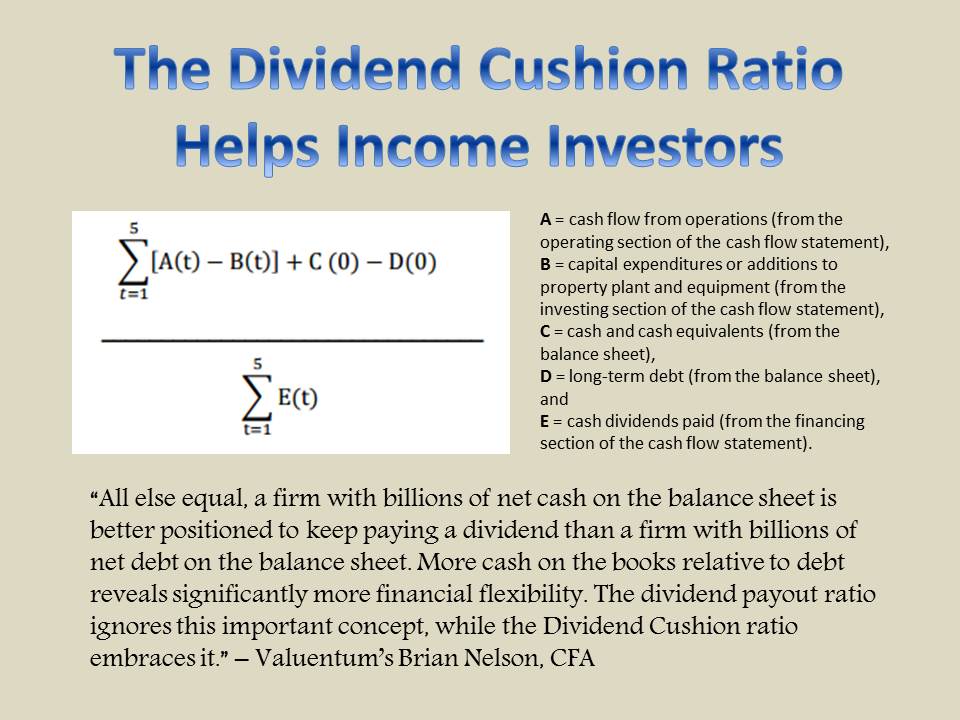


Image: Dick’s Sporting Goods is the premiere sporting goods retailer, and the firm’s performance during its recently reported fiscal third quarter showed a key inflection point in same-store-sales growth. Image Source: Dick’s Sporting Goods. On November 22, Dick’s Sporting Goods reported fiscal third quarter results for the period ending October 29 that beat expectations on both the top and bottom line, but the real story was the sporting good retailer’s same-store sales performance, which far exceeded the consensus expectation for the period. With a forward estimated dividend yield of ~1.8% and a solid Dividend Cushion ratio of 3.3, Dick’s Sporting Goods remains one of our favorite ideas within the Dividend Growth Newsletter portfolio.